

Cosmetic product packaging represents a veritable ‘best of’ all existing formats. Tubes, pots, jars, sachets and palettes
protect high-end products, which are often made with natural raw materials, ranging from serums, creams and gels to make-up powders. As these dynamic markets call for frequent portfolio changes, manufacturers need to package their valuable creations with exceptional care and flexibility – in high-speed environments and often on a limited footprint. Reliably meeting these demands calls for compact, automated solutions.
Mastering any format
The sheer variety of packaging in the cosmetic sector mirrors consumers’ many different tastes and preferences. From personal hygiene to beauty care, they expect an extensive range of high-quality products, which manufacturers are willing to provide in versatile packaging that allows the products to be used in the best possible way. Pump bottles, jars and palettes provide protective outer casings for liquid and solid products, including face creams, masks, shampoos and powders.
This vast array of formats can lead to considerable challenges for manufacturers – often without significant line expansions. For reasons of space or economy, many companies aim to keep their production lines compact while drastically increasing flexibility simply to keep up with demand and maintain high line efficiency. This often requires fully automated single lines with advanced packaging technology to help manufacturers save space and secure a short time-to-market.
Robots get the job done
High-efficiency processes are integral to every stage of the packaging line, from picking and placing individual products to erecting, filling and closing boxes or cases. Advanced robots equipped with high-precision vision systems, cutting-edge gripping and suction tools, and mobile in-line transport units significantly contribute to seamless packaging operations at all times.
For instance, highly sought-after lip balm sticks and face masks can be easily processed on the same packaging line. Lip balm sticks are placed into single or double cardboard blisters, while face masks in four-side-seal pouches are displayed upright in cartons. These products, which are temporarily stored in crates and fed into the packaging line as bulk goods, need to be inspected and sorted before moving on to the next packaging step. Image processing programmes assist manufacturers in checking the quality of these products, passing on the location and position of each individual sachet to intelligent F4 pick & place robots. This calls for advanced inspection technology and seamless interaction between the vision systems and pick & place robots. For instance, 2D scanners capture the shape, colour and orientation of individual items for quality control evaluation. Schubert, a trailblazer in image processing, has been developing 2D and 3D cameras since the mid-80s, laying the groundwork for highly efficient packaging operations that leave no irregularity unnoticed.
Scanners don’t keep their vital information to themselves. Via interfaces with the robots’ control systems, they exchange recorded product data with handling robots, such as the agile four-axis SCARA robot F4, therefore lending them a helping hand. Communication networks such as these are ideal for applications where quick, reliable data transmission is key. Thanks to real-time bus systems, robots receive coordinates at two-millisecond intervals.
This enables data from up to 10,000 products to be transferred per minute — an essential prerequisite for processing large quantities reliably and quickly. In the case of face mask pouches, for example, the F4 pick & place robots rotate products lying incorrectly (e.g. on their front due to handling motions) and place them into the carton in the correct orientation. This ensures not only the right product count, but also that the products are appealing to the consumer.
Keeping it compact
High speeds and accuracy don’t necessarily require robots that are permanently installed in the production line, like the F4. In space-saving layouts, collaborative robots can scan, pick and place items just as effectively, while needing only minimal programming and integration time. Schubert developed the nimble tog.519 handling robot with this in mind. It is the fastest ‘bin picking’ robot on the market and can achieve an output of up to 90 cycles per minute – on a highly compact footprint. A vision system with two 2D cameras generates a three-dimensional image via AI algorithms and, thanks to prior ‘training’, recognises objects from different categories. This enables the system to check the quality of individual sachets, as mentioned previously, as well as virtually any other object – as long as it belongs to a category the robot has been trained to recognise, such as a pouch, bottle, or lid. The secret lies in the pre-programmed processes that operators can adjust at any time. The aforementioned scanners are ‘aware’ of these parameters and monitor the products accordingly. Before closing, the filled containers undergo another height check, during which a 3D scanner verifies that all the palettes have been correctly positioned within the notched compartments.
Printed to measure
Cosmetics packaging comes in many different shapes and sizes, and the robots’ gripping and suction tools need to be equally versatile. Both speed and accuracy are decisive throughout the entire process. Tools that adapt to the shape of each product and container ensure that they are picked up safely and that neither the packaging nor the delicate cosmetics inside are damaged. This can be achieved with absolute reliability via 3D printing, which allows parts to be designed individually prior to printing and stored for future use. Since print jobs and 3D models with certified work sequences are available on demand, spare or wear parts that were previously kept in stock or replenished in a time-consuming manner can be obtained much more quickly.
Furthermore, frequently used equipment and devices can be quickly reprinted or duplicated using 3D printing. This secures one of the most pivotal steps in small-batch manufacturing – quick changeovers. State-of-the-art packaging lines are therefore increasingly using 3D-printed robot tools. This significantly reduces costs while minimising downtime.
Ready for shipping
As most products require secondary packaging for transport and display purposes, cartoning systems – yet another fully automated packaging step – are used to erect, glue, fill and close previously flat blanks in the shortest possible time. Pick & place robots pick up the primary packaging and place it onto mobile transport robots, such as Schubert’s Transmodul. This compact machine uses a rail system that runs through all sub-machines of a packaging line. The Transmodul can carry a wide variety of packaging formats and allows easy changeovers. Only the transport tools need to be replaced to switch between formats.
Cartoners ensure that individual products are safely protected during transport and can do so at astounding speeds. Thanks to their well-sized magazines that can hold several thousand blanks, Schubert’s TLM cartoners produce boxes for a prolonged amount of time. Depending on the type of magazine, uninterrupted cartoning can range from one to several hours: Schubert’s latest single-lane vertical magazine can accommodate up to two blank stacks, enabling up to 60 minutes of uninterrupted cartoning. Schubert’s vertical pallet magazine “Comfort Feeder”, in turn, allows for four to five hours of cartoning before a new pallet has to be loaded. Innovative erecting units, such as the A3, help save additional space, as single-lane erectors significantly reduce the system’s overall footprint. More importantly still, they achieve high double-digit outputs per minute, ensuring that the coveted products are ready for shipping in no time at all.
Handling any format
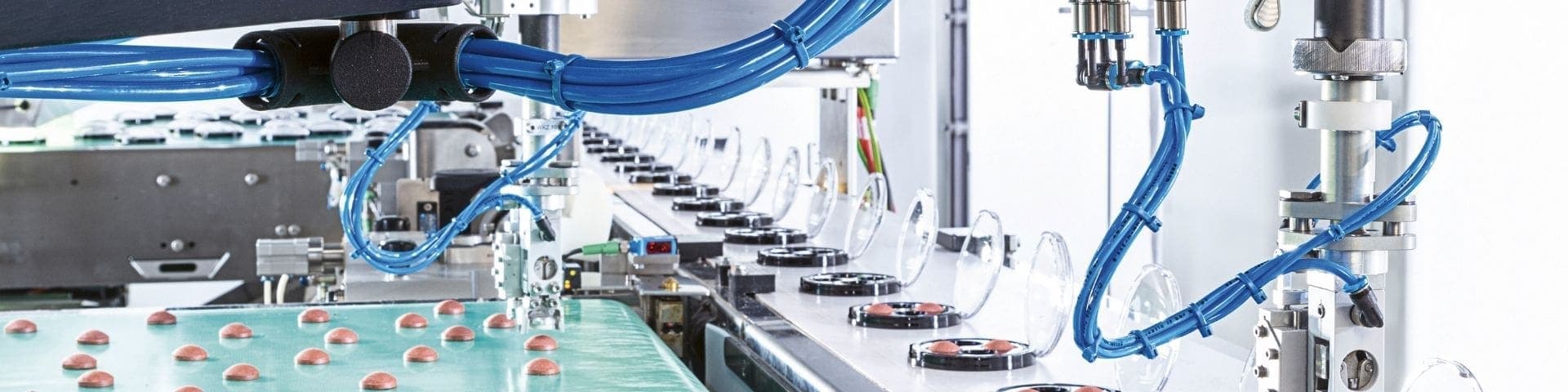
Not all packaging, however, is as straightforward as a bottle or jar. Some cosmetic products, such as powder, blusher and eyeshadow, consist of palettes of pressed or baked powders that are placed in notched compartments inside special containers. Pick & place robots are highly effective for these applications, as they grip the pressed products gently and consistently. This ensures outstanding quality even at high speeds.