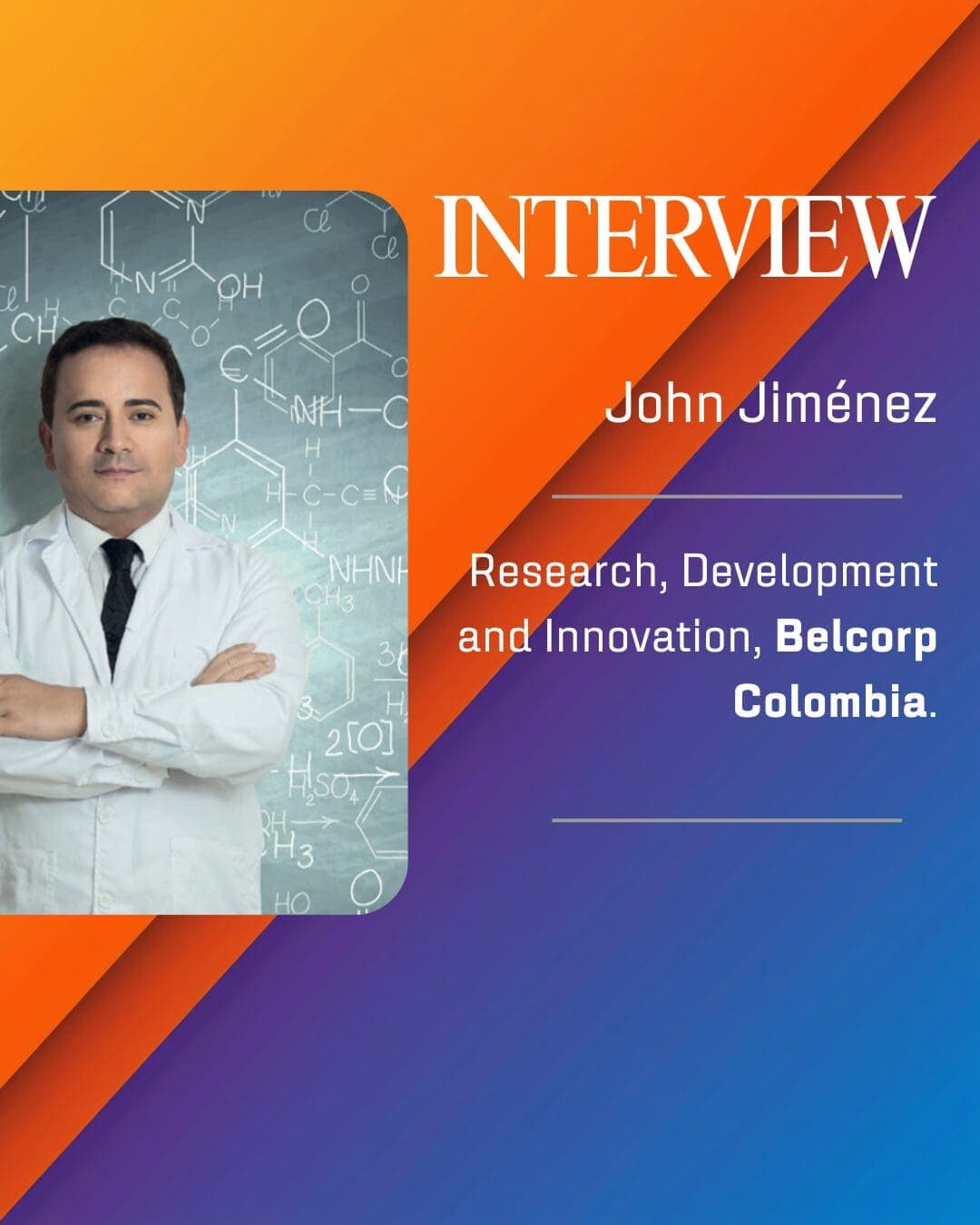
A conversation with John Jiménez, Senior Researcher Expert at Belcorp
If I had to define the cosmetic of the future in a single word, it would be ‘necessity’

Euro Cosmetics:
John, first of all, congratulations on your 20th anniversary with Belcorp. Looking back, what first sparked your interest in cosmetic science—and what have been the most defining chapters of your professional journey so far?
John Jiménez:
I am deeply grateful for this space and for the opportunity to share my personal vision on the evolution of our industry and the emerging trends shaping cosmetic science with the magazine’s readers. I truly value the relationship we have built with EURO COSMETICS since 2020, when I first began writing for Neuro-Sensory Insights column. Over the past six years, we have sustained a meaningful and ongoing dialogue with the audience within a rich academic and professional context, one that has not only nurtured my own thinking, but has also fostered a vibrant exchange of ideas with scientists and experts from across the international community.
My interest in cosmetic science arises from the extraordinary pace at which this discipline evolves, particularly when compared to other fields of applied science. Innovation in cosmetics is driven not only by technology, but also by a deep understanding of human biology, perception, and emotion—an intersection that has continuously inspired my career. I had the privilege of being born and raised in Colombia, where from an early age I was immersed in rich biodiversity and the culture of coffee growing. Both have profoundly shaped my way of thinking and observing the natural world. My passion for coffee and wine – two sectors deeply connected to sensory experience, craftsmanship, and origin – has been a constant source of inspiration for cosmetic research, especially in the study of sensoriality, formulation, and storytelling. I am a pharmacist from the National University of Colombia, where I had my first formal introduction to cosmetic chemistry. My thesis focused on developing an alternative in vitro method for eye irritation testing using cell cultures, a project I presented with my thesis partner at the Latin American Congress of Cosmetic Chemistry (Argentina, 2001) and the Latin American Congress of Alternative Methods (Cuba, 2001). These formative experiences confirmed my commitment to this field. Subsequently, I expanded my training with specialization studies in Cosmetic Science, Marketing, and Neuromarketing, as well as a Master’s degree in Sustainable Development. In 2005, I joined Belcorp as Senior Head of Skincare R&D category. I am deeply grateful to the company for the support and trust given over the years, in an environment that has promoted research, innovation and collaborative work with exceptional R&D teams, decisively shaping my professional career.
Euro Cosmetics:
Over the years, which experiences or turning points most shaped your perspective on the personal care industry?
John Jiménez:
Several pivotal moments have shaped my perspective on the cosmetics industry, gaining an understanding – through applied research – that this field integrates science, health, and human behavior was especially formative. Working with scientific data that translates directly into everyday products has strengthened my sense of responsibility to develop solutions that are safe, effective, and evidence-based solutions.
It was also crucial to observe the gradual shift towards a more conscious, inclusive, and sustainable industry. Participating in research related to more responsible ingredients, processes, and formulations reinforced my conviction that science must anticipate not only technical needs but also long-term environmental, human, and social impacts. Over time, I came to understand that beauty is a universal right and that all human beings have the need to look and feel good. Inclusion will continue to be a fundamental driver of cosmetic innovation.
Euro Cosmetics:
What key milestones—such as your academic background, recognitions, or publicly shareable research projects—have been most influential for you professionally?
John Jiménez:
Over the span of my professional career, I have participated in numerous research projects and published articles in international scientific journals. In 2003, along with two colleagues, we identified and characterized the potential of laurel wax as a functional ingredient for makeup formulations. It is an exotic raw material, originating from rural and jungle regions of Colombia. This work was recognized in 2004 with the Maison G. de Navarre Award granted by the IFSCC, a distinction that marked a significant milestone in my career.
From that moment on, a period of intense scientific activity was consolidated, marked by research, publications and participation in international conferences with fellow scientists, which resulted in several awards, including the Best Scientific Paper award at Colamiqc 2009 (Ecuador) and 2013 (Brazil), Farmacosmética 2014 (Colombia), and the IFSCC Henry Maso Award 2016 (USA). This trajectory allowed me to collaborate for several years as a judge for the in-cosmetics Global, Latin America, Korea, and Asia innovation awards. Also, since 2010, I have been a columnist for Cosmetics & Toiletries Brazil and, since 2019, for in-cosmetics Connect. In 2016, I was invited to join the Scientific Advisory Board of Cosmetics & Toiletries USA.
One of the most significant milestones in my career occurred in 2023, when I was invited as a Keynote Speaker at the IFSCC World Congress in Barcelona. My presentation on sensory inclusion was a profoundly enriching academic and personal experience, and it was commented by several international journals. That same year, the IFSCC invited me to participate as co-editor of the journal for Zone 3 (Americas), an experience that has allowed me to appreciate the IFSCC’s work in promoting cosmetic science globally. Additionally, in the professional sphere, I served as president of ACCYTEC (Colombian Association of Cosmetic Chemists), Bogotá chapter, from 2017 to 2019.
Euro Cosmetics:
Which macro trends do you see as most impactful for the industry right now (e.g., wellness, sustainability, digitalization, biotech, regulation)?
John Jiménez:
To introduce the first trend, I draw on insights from one of my latest columns published on the incosmetics connect platform. The global cosmetics market is among the most dynamic industries, with an estimated value of US$380 billion in 2026 and a projected US$560 billion by 2032, reflecting a CAGR of 6.64%. Market growth is regionally diverse rather than uniform. AsiaPacific leads skincare innovation and preventive routines, Europe drives dermocosmetics, and the United States focuses on inclusivity and clean beauty. Africa stands out in haircare, while Latin America shapes trends in fragrances, body care, and haircare. This regional specialization highlights how cultural and consumer differences actively shape global cosmetic trends.
In hair care we’re experiencing a complete shift from facial concepts to those focused on the hair fiber and scalp. This explains the boom in concepts like hair essences and glass hair. In skincare, a particularly interesting trend is minimalist beauty, reflected in two aspects: a reduction in the number of steps in countries and regions where routines are lengthy, and, on the other hand, multifunctional products with a comprehensive effectiveness profile that can help shorten these routines. The pandemic left us with a legacy of increased at-home facial care and, above all, a surge in aesthetic procedures, which is why pre- and post-procedure skincare is an important trend.
On the other hand, something interesting is happening in the wine industry that could inspire the cosmetics industry. It turns out that wine consumption is declining globally, and companies that produce high-end red and white wines are trying to simplify their communication regarding sensory and olfactory descriptions, terroir, and geographical characteristics, using simpler language for new consumers in Generation Z and the upcoming Generations Alpha and Beta. Undoubtedly, cosmetic brands will also try to simplify their communication related to biochemical mechanisms and benefits, using simpler language for these new consumers.
Biochemical inclusion is also one of the areas I see as most promising for the future of cosmetics. Inclusion is a universe yet to be discovered, and, for example, genderless concepts are just one planet in that vast world. At future conferences and trade shows, we will see new biochemical mechanisms to prevent and counteract the effects on skin and hair of states such as anxiety, anger, sadness, and emotions in general, as well as specific medical conditions such as hyperactivity, ADHD, and others.
Euro Cosmetics:
From your perspective, what is changing in how consumers define “efficacy” and “value” in personal care?
John Jiménez:
From my perspective, the concepts of efficacy and value in cosmetics are evolving significantly and becoming much more complex than in the past. Traditionally, efficacy was primarily associated with visible and immediate results. Today, consumers incorporate broader criteria, such as scientific evidence of benefit, an understanding of the mechanism of action, consistency of long-term results, and safety in use. There is a growing expectation of clear scientific backing, transparent data, and well-founded claims. In this sense, the language of science – when well communicated – has become central to building trust.
In parallel, the concept of value is no longer solely dominated by price or functional performance. Consumers evaluate value more holistically, integrating aspects such as ingredient sustainability, the product’s environmental impact, inclusivity, ethical supply chain practices, and alignment with their own personal values. A product may be technically effective but lose value if it fails to meet these broader expectations.
Euro Cosmetics:
What role will science, substantiation, and transparency play in building consumer trust going forward?
John Jiménez:
Today’s consumers are much better informed and more critical of the products they buy. For this reason, these three elements will not only play a central role in building consumer trust but will be their fundamental pillars. Trust is therefore shifting from being based on promises to depending on evidence.
Science provides the framework for credibility. Consumers expect cosmetics to be backed by solid data, clear methodologies, and evaluation criteria based on recognized scientific standards. A lack of scientific rigor quickly translates into a loss of trust, which is why substantiation plays a fundamental role, as claims must be supported by relevant studies, appropriate experimental designs, and metrics that are meaningful to the end user. In this context, overinterpreting results or using ambiguous technical language becomes reputational risks, especially in an increasingly vigilant regulatory and social environment.
Transparency acts as the link between science and trust. It’s not just about showcasing positive results, but about honestly communicating what has been evaluated, under what conditions, and to what extent. A willingness to share information about ingredients, processes, testing methods, and safety criteria reinforces the perception of scientific integrity and ethical commitment. Brands that successfully integrate rigorous science, solid evidence, and consistent transparency will not only build greater trust, but also more lasting relationships with consumers.
Euro Cosmetics:
Looking ahead, what do you see as the most important opportunities for innovation at a high level?
John Jiménez:
I believe the most significant opportunities for innovation in cosmetics lie in the convergence of advanced science, sustainability, inclusivity, and a deep understanding of the consumer. From a scientific perspective, there is enormous potential in developing active ingredients with increasingly precise and differentiated mechanisms of action, supported by cutting-edge skin biology, omics approaches, predictive models, and data and artificial intelligence tools that accelerate the design and validation of more effective and safer ingredients and formulations. Simultaneously, personalization based on biology, lifestyle, and environment represents a key opportunity to redefine the value proposition of cosmetic products. Chemical segmentation of the consumer, based on assessments of specific markers (such as cortisol), also presents a major opportunity. From an environmental and social perspective, innovation will be strongly driven by sustainable design.
Looking ahead, artificial intelligence is emerging as a true backbone of cosmetic innovation. Its integration will enable the development of more precise, verifiable claims that are representative of the true diversity of consumers, driving a more inclusive and data-driven approach to cosmetics. If I had to define the cosmetic of the future in a single word, it would be “necessity”: new formulas, routines, and formats will need to adapt flexibly to users’ evolving lifestyles, habits, and expectations, offering relevant and personalized solutions. Finally, one of the most consistent trends observed at recent scientific conferences and in specialized publications is longevity. This focus is solidifying as a key driver for the development of new active ingredients and the exploration of innovative biochemical mechanisms, geared not only towards immediate appearance but also towards maintaining long-term skin function, setting a clear direction for cosmetic research in the coming years. Wellness, seniors, and the microbiome are also emerging as major opportunities for innovation.
Euro Cosmetics:
What advice would you give to young scientists and innovators entering the cosmetic industry today?
John Jiménez:
I recommend that young scientists starting their careers in the cosmetics industry actively seek visibility and participation within the global scientific community. Presenting research at international conferences and working towards publication in leading scientific journals is essential, not only to validate scientific rigor but also to build credibility, collaborative networks, and sustained visibility within the industry. These platforms open doors to collaborations, funding opportunities, and meaningful dialogue between academia and industry.
At the same time, I believe it is important for young researchers to design projects with real-world impact in mind. Scientific excellence and social relevance must go hand in hand. Research that addresses local resources, regional biodiversity, unmet consumer needs, or sustainable technologies can contribute not only to innovation but also to the development of initiatives that create jobs and foster economic growth in their own countries.
I also advise adopting an interdisciplinary and inclusive approach. Modern cosmetic science lies at the intersection of chemistry, biology, materials science, psychology, medicine, data analysis, sustainability, and regulatory affairs. Developing strong communication skills – both scientific and non-scientific – is equally crucial, as the ability to clearly explain mechanisms, data, benefits, and studies to both scientific audiences and general consumers is fundamental in our industry.
Finally, perseverance and ethical responsibility are essential pillars of scientific innovation. The cosmetics industry is evolving at an unprecedented pace, and resilience in the face of complexity and uncertainty has become indispensable. Young innovators must cultivate deep curiosity, scientific rigor, and an unwavering commitment to responsible research, ensuring that advances in cosmetic science genuinely benefit consumers, society, and the environment. Inclusivity is not optional – it is fundamental to the future of innovation. I encourage young researchers to pursue their work with passion, to continue exploring relentlessly and to unlock their full potential in everything they do. This is precisely what the industry needs today. There is no better cosmetic product than one designed by a consumer for consumers – rooted in real needs, lived experiences, and authentic understanding.
Euro Cosmetics:
John, thank you for your time and for sharing your perspectives with EURO COSMETICS.
John Jiménez: Thanks again for the invitation. I take this opportunity to invite all readers to stay connected with EURO COSMETICS, both in print and digital versions, to keep up to date with the latest cosmetic news.
Note: The opinions and perspectives expressed belong exclusively to the interviewee.